RESEARCH
Quantitative Ultrasound-Guided Precision Theranostics
TURE Laboratory develops quantitative ultrasound technologies that integrate tissue characterization, treatment planning, programmable acoustic energy deposition, and treatment monitoring. Our research aims to transform ultrasound from a primarily diagnostic modality into an integrated platform for precision, image-guided theranostics.
Research Programs
Our research spans four interconnected programs built around quantitative ultrasound imaging, programmable acoustic field control, and image-guided intervention.
qUST-Guided Rapid Drug Testing and Multidrug Microdosing in Solid Tumors
Explore Project ↓ 02qUST-Guided Targeted Drug Delivery for Hard-to-Treat Cancers
Explore Project ↓ 03Transcranial qUST Imaging and Image-Guided Therapy
Explore Project ↓ 04Nanodroplet-Assisted qUST-Guided Histotripsy
Explore Project ↓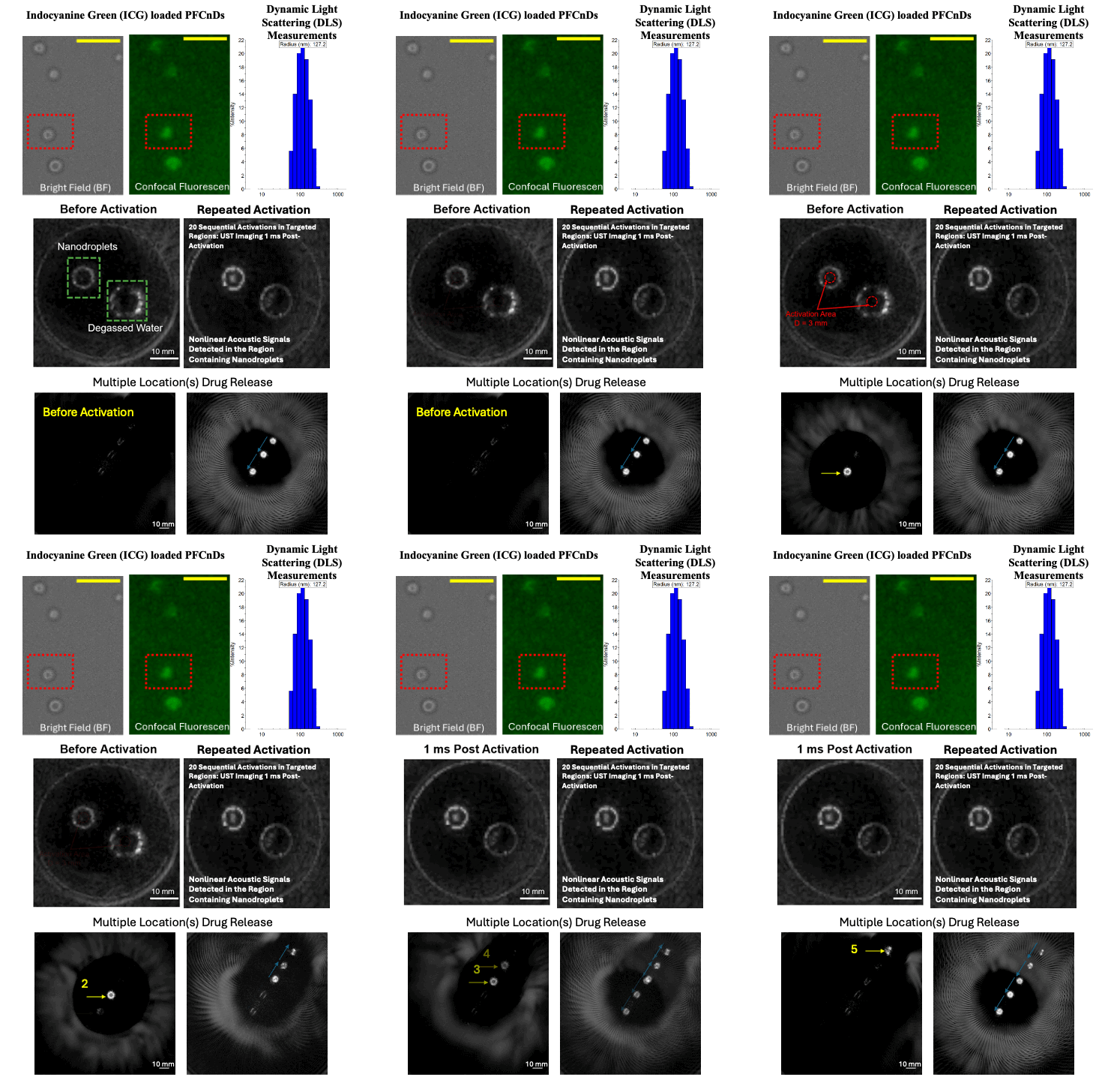
qUST-guided spatially multiplexed drug testing within an intact solid tumor.
qUST-Guided Rapid Drug Testing and Multidrug Microdosing in Solid Tumors
Research Challenge
Solid tumors are spatially heterogeneous, and drug response measured using molecular profiling, cell culture, or ex vivo models does not fully capture therapeutic behavior within the intact tumor microenvironment. Directly comparing multiple candidate therapies in vivo remains difficult because conventional systemic treatment exposes the entire tumor and the patient to each drug.
Our Approach
We are developing a qUST-guided spatially multiplexed drug-testing platform in which quantitative ultrasound defines tumor geometry and treatment coordinates, while programmable acoustic fields trigger localized release from ultrasound-responsive carriers at prescribed positions inside the tumor.
Technology Development
This research integrates quantitative tissue characterization, spatial treatment planning, ultrasound-responsive drug carriers, ring-array acoustic field control, and localized response assessment to create an image-guided virtual microdosing platform.
Potential Impact
The long-term goal is to enable multiple candidate therapies to be evaluated within the same intact tumor while preserving the native vascular, stromal, immune, and extracellular-matrix environment that shapes treatment response.
Image-guided activation of ultrasound-responsive carriers for localized drug delivery.
qUST-Guided Targeted Drug Delivery for Hard-to-Treat Cancers
Research Challenge
Therapeutic delivery can be especially difficult in tumors with dense stromal architecture, heterogeneous vascular perfusion, poor drug penetration, or anatomically challenging locations. Systemic administration can also produce substantial off-target exposure while delivering only a fraction of the administered dose to the intended tumor region.
Our Approach
TURE Laboratory is developing quantitative ultrasound-guided methods that localize and characterize tumors, plan acoustic treatment, and activate ultrasound-responsive carriers directly within selected regions. The goal is to spatially control where therapeutic payloads are released.
Technology Development
The platform combines qUST, programmable ring-array focusing, phase-changing nanodroplets, acoustic activation, and quantitative monitoring. Our work investigates activation thresholds, targeting accuracy, treatment volume, and off-target exposure.
Potential Impact
Image-guided localized release could improve therapeutic concentration at difficult tumor targets while reducing unnecessary systemic exposure and enabling personalized treatment strategies based on tumor-specific acoustic and structural characteristics.
Quantitative transcranial imaging and physics-based acoustic field planning through the skull.
Transcranial qUST Imaging and Image-Guided Therapy
Research Challenge
The skull strongly refracts, attenuates, and distorts ultrasound waves, creating a major barrier for both quantitative brain imaging and precise transcranial therapy. Reliable intervention therefore requires knowledge of the patient-specific acoustic propagation environment as well as methods for compensating skull-induced aberration.
Our Approach
We investigate transcranial qUST methods that reconstruct quantitative acoustic properties and use those measurements to inform image-guided treatment planning. Physics-based modeling and full-wave reconstruction are used to connect imaging information with therapeutic field control.
Technology Development
Current directions include transcranial quantitative imaging, realistic acoustic simulation, full-wave inversion, aberration compensation, and programmable ultrasound field synthesis for noninvasive brain interventions.
Potential Impact
An integrated imaging-and-therapy platform could support future applications in brain injury assessment, hemorrhage intervention, blood-brain-barrier modulation, and other precisely targeted transcranial ultrasound therapies.
qUST-guided acoustic targeting with phase-changing nanodroplets for spatially controlled mechanical therapy.
Nanodroplet-Assisted qUST-Guided Histotripsy
Research Challenge
Histotripsy uses intense ultrasound-induced cavitation to mechanically disrupt tissue without surgical access. Achieving highly localized cavitation while controlling treatment exposure remains a central challenge, particularly when treating heterogeneous or anatomically sensitive targets.
Our Approach
We are investigating phase-changing nanodroplets as localized cavitation nuclei that can be activated using qUST-guided programmable ultrasound fields. The approach is designed to combine quantitative target localization with spatial control of mechanical treatment.
Technology Development
This research integrates nanodroplet formulation, acoustic vaporization, ring-array field shaping, quantitative ultrasound imaging, and treatment monitoring. We study how carrier properties and acoustic exposure influence activation and mechanical treatment localization.
Potential Impact
Nanodroplet-assisted histotripsy may provide a route toward more spatially selective mechanical therapy with image-guided treatment planning and monitoring, particularly for targets where conventional high-amplitude focusing is challenging.
Integrated Research Platform
Across these programs, TURE Laboratory develops a common technical framework that connects quantitative imaging, acoustic field control, responsive therapeutic agents, precision intervention, and treatment monitoring.